
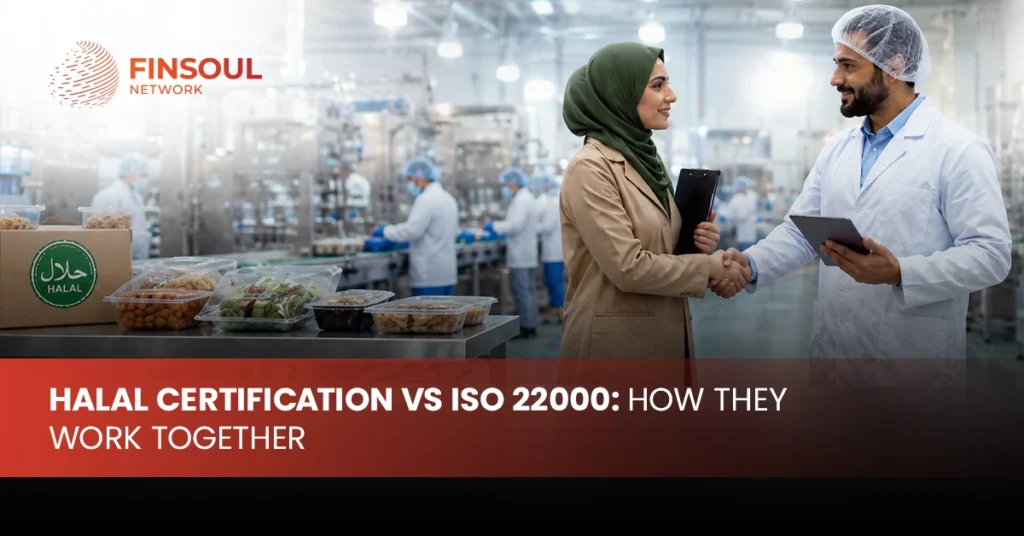
Global demand for food that is both safe and Halal compliant continues to rise every year. Many food businesses assume they must choose one certification over the other, when in reality Halal Certification and ISO 22000 work best when implemented side by side.
ISO Consultancy Qatar breaks down what each standard covers, where they overlap, and how food businesses can build one integrated system that satisfies both religious and safety requirements.
Understanding Halal Certification
Halal Certification confirms that a product meets Islamic dietary law from sourcing through to packaging. It gives consumers confidence that what they are buying is permissible under Islamic principles.
- Definition of Halal: Halal means permissible under Islamic law, and it applies to ingredients, processing methods, and handling practices.
- Purpose of Halal Certification: It verifies that a product has been produced, stored, and transported without contact with prohibited substances.
- Food manufacturing: Manufacturers need certification to confirm ingredients and processes meet Halal standards throughout production.
- Meat and poultry processing: Slaughter methods, handling, and storage must follow strict Halal guidelines at every stage.
- Dairy and beverage production: Additives, flavourings, and processing aids must be checked to avoid non-Halal contamination.
- Restaurants and catering services: Kitchens must maintain segregation between Halal and non-Halal ingredients and equipment.
- Cosmetics and pharmaceuticals: In some markets, Halal Certification extends beyond food into personal care and medicine.
Understanding ISO 22000
ISO 22000 is an internationally recognised standard for Food Safety Management Systems. It gives businesses a structured way to identify, control, and reduce food safety risks.
What Is ISO 22000:2018
ISO 22000:2018 combines hazard analysis principles with a management system approach that fits businesses of any size. It requires organisations to look at their entire supply chain, not just the production floor. This makes it useful for manufacturers, processors, packaging companies, and even logistics providers who handle food products.
Key Objectives of ISO 22000
The standard is built around a few core goals that guide how a food safety system should function day to day. These goals help businesses stay ahead of risks rather than reacting after problems occur. Meeting them consistently is what earns and keeps certification.
- Food safety: Ensures products are safe for consumption at every stage of production and distribution.
- Hazard prevention: Identifies biological, chemical, and physical hazards before they reach the consumer.
- Risk management: Builds controls around each identified hazard to keep risk at an acceptable level.
- Regulatory compliance: Helps businesses meet local and international food safety laws.
- Continual improvement: Requires regular review and updates to keep the system effective over time.
Halal Certification vs ISO 22000: Key Differences
Both standards deal with food, but they answer different questions. Halal Certification asks whether a product is permissible, while ISO 22000 asks whether a product is safe.
| Feature | Halal Certification | ISO 22000 |
| Primary objective | Religious compliance | Food safety assurance |
| Focus | Ingredients, sourcing, and processing methods | Hazard identification and control |
| Scope | Product and supply chain from a religious lens | Entire food safety management system |
| Religious requirements | Mandatory | Not included |
| Food safety requirements | Limited, mainly hygiene related | Core requirement |
| Risk management | Focused on contamination with non-Halal items | Focused on biological, chemical, and physical hazards |
| Documentation | Halal policy, sourcing records, segregation logs | HACCP plan, hazard analysis, PRPs, audit records |
| Audits | Conducted by Halal certification bodies | Conducted by accredited ISO certification bodies |
| Applicable industries | Food, cosmetics, pharmaceuticals in some regions | Any organisation in the food supply chain |
| Certification body | Islamic authority or accredited Halal body | ISO accredited certification body |
How Halal Certification and ISO 22000 Complement Each Other
Neither standard replaces the other, but together they cover both dimensions of food quality that customers care about most.
Different Objectives, Shared Goals
Halal Certification verifies compliance with Islamic dietary requirements, while ISO 22000 ensures food is safe through a systematic food safety management system. When combined, they help businesses produce food that is both Halal and safe for consumption. A product can be Halal without being safe, and it can be safe without being Halal, which is why relying on only one standard leaves a gap. Businesses that implement both close this gap and build trust with a wider customer base.
Areas Where Halal Certification and ISO 22000 Overlap
- Food hygiene: Both standards require clean facilities, proper handling, and controlled storage conditions.
- Traceability: Each system needs records showing where ingredients came from and how they were processed.
- Supplier management: Suppliers must be evaluated for both Halal compliance and food safety practices.
- Process controls: Production steps need monitoring to prevent contamination and maintain consistency.
- Employee training: Staff need to understand both religious requirements and food safety procedures.
- Documentation and internal audits: Records and audit schedules can often be combined into one system with separate checklists.
Implementing one system can genuinely support the other, since many procedures such as cleaning schedules and supplier checks serve both purposes at once. However, each standard still has requirements that are unique to it, so businesses cannot assume full overlap.
Key Requirements of Halal Certification
Meeting Halal Certification requirements means controlling the entire journey of a product from raw material to finished goods.
- Approved ingredients: Only ingredients from approved Halal sources can be used in production.
- Segregation of Halal and non-Halal materials: Separate storage and equipment prevent accidental mixing.
- Prevention of cross-contamination: Cleaning procedures must remove any trace of non-Halal substances.
- Slaughter requirements: Where applicable, animals must be slaughtered according to Islamic law.
- Packaging and labelling: Labels must accurately reflect Halal status without misleading claims.
- Traceability and record keeping: Every batch needs documentation linking it back to approved sources.
Key Requirements of ISO 22000
ISO 22000 requires a structured management system that covers leadership commitment down to daily operational checks.
- Context of the organisation and leadership: Management must define food safety objectives and allocate resources.
- Hazard analysis and HACCP principles: Businesses must identify hazards and set controls at critical points.
- Prerequisite Programmes (PRPs): Basic conditions like pest control and cleaning support the wider system.
- Operational PRPs (OPRPs) and CCP monitoring: These target specific hazards that need closer control.
- Emergency preparedness: Plans must be in place for incidents such as recalls or contamination events.
- Internal audits and management review: Regular checks confirm the system is working and highlight areas for improvement.
The Role of HACCP
HACCP, or Hazard Analysis and Critical Control Points, sits at the core of ISO 22000 and also supports Halal food safety indirectly.
HACCP and Halal Food Safety
HACCP identifies hazards at each stage of production and sets critical control points where those hazards can be prevented or reduced. This process includes monitoring, corrective actions, and verification steps that confirm controls are working as intended. When applied alongside Halal requirements, HACCP helps ensure that contamination risks, whether from unsafe bacteria or non-Halal substances, are caught before products reach the consumer.
Benefits of Implementing Both Certifications
Businesses that hold both certifications tend to see advantages that reach beyond compliance paperwork.
- Enhanced consumer confidence: Customers trust products that are verified as both safe and Halal.
- Stronger food safety controls: Combining systems reduces gaps that a single standard might miss.
- Increased export opportunities: Many countries require both certifications for market entry.
- Better access to Muslim-majority markets: Halal Certification opens doors that ISO 22000 alone cannot.
- Reduced contamination risks: Overlapping controls catch more potential hazards.
- Competitive advantage and brand reputation: Dual certification signals quality to buyers and retailers alike.
Which Businesses Should Implement Both?
- Food manufacturers and processors: Any business handling raw ingredients through to finished products benefits from dual coverage.
- Meat and poultry producers: These businesses face the highest scrutiny for both safety and Halal compliance.
- Beverage companies and dairy manufacturers: Additives and processing aids need checks from both angles.
- Catering companies, hotels, and restaurants: Food service businesses serving diverse customers need both assurances.
- Food packaging companies and exporters: Packaging integrity and international trade requirements often demand both standards.
- Private label manufacturers: Retail partners frequently require proof of both certifications before signing contracts.
How to Implement Halal Certification and ISO 22000 Together
A structured rollout keeps the process manageable and avoids duplicated work between the two systems.
Step 1: Conduct Gap Analysis
Begin with a gap analysis to identify where current practices fall short of either standard. This helps establish a clear roadmap for compliance.
Step 2: Define Halal Requirements
Determine which Halal requirements apply to your specific products and processes. This ensures the certification scope is accurate and relevant.
Step 3: Develop ISO 22000 FSMS
Start building the ISO 22000 Food Safety Management System (FSMS) that will house both food safety and Halal controls, creating a unified framework.
Step 4: Implement Prerequisite Programmes
Introduce hygiene, pest control, and facility maintenance programmes to establish a strong foundation for food safety.
Step 5: Perform Hazard Analysis
Carry out a full hazard analysis to identify risks across the production line, ensuring food safety risks are systematically addressed.
Step 6: Establish Halal Controls
Set up Halal‑specific measures such as segregation zones, approved supplier lists, and ingredient verification to integrate seamlessly with ISO 22000.
Step 7: Train Employees
Provide training on both food safety procedures and Halal requirements so daily operations consistently reflect both standards.
Step 8: Conduct Internal Audits
Run internal audits to identify gaps and correct issues before external certification audits take place.
Step 9: Undergo Certification Audits
Engage accredited certification bodies to conduct audits for both ISO 22000 and Halal compliance, ensuring readiness and credibility.
Step 10: Maintain Compliance
Focus on continual improvement through regular reviews, updates, and refresher training to sustain certification over time.
Documentation Required
- Food Safety Policy and Halal Policy: These set the overall direction and commitment for each system.
- HACCP Plan and Hazard Analysis: These documents identify risks and the controls in place to manage them.
- Approved Supplier List and Ingredient Specifications: These confirm sourcing meets both safety and Halal standards.
- Traceability Records: These track products from raw material to finished goods.
- Training Records and Internal Audit Reports: These show staff competency and ongoing system checks.
- Corrective Action Records and Management Review Minutes: These demonstrate that issues are addressed and reviewed at the leadership level.
Common Challenges When Implementing Both Standards
- Lack of employee awareness: Staff may understand one standard well but not the other, creating gaps in daily practice.
- Supplier compliance issues: Suppliers may meet safety requirements but not Halal sourcing rules, or the reverse.
- Cross-contamination risks: Shared equipment or storage space can compromise both systems at once.
- Poor documentation and weak traceability: Incomplete records make it difficult to prove compliance during audits.
- Maintaining compliance across multiple sites: Consistency becomes harder as operations expand to new locations.
Best Practices for Integrated Compliance
- Develop one integrated management system: Combine procedures where possible to reduce duplication and confusion.
- Train all employees regularly: Refresher training keeps both standards fresh in daily operations.
- Conduct supplier evaluations: Regular checks confirm suppliers continue to meet both sets of requirements.
- Strengthen traceability systems: Better tracking makes audits faster and more accurate.
- Perform regular internal audits: Frequent checks catch problems early, before they affect certification status.
Common Myths
- “ISO 22000 automatically includes Halal Certification.” This is false, since ISO 22000 does not address religious dietary law at all.
- “Halal Certification only applies to meat products.” Halal Certification covers a wide range of food, cosmetics, and pharmaceutical products.
- “Small food businesses don’t need ISO 22000.” Businesses of any size can benefit from a structured food safety system.
- “Both certifications require duplicate documentation.” Many records, such as supplier lists and training logs, can be shared across both systems.
- “Once certified, no further audits are required.” Both certifications require ongoing surveillance audits to maintain status.
Conclusion
Halal Certification and ISO 22000 are complementary rather than competing standards. While Halal Certification focuses on compliance with Islamic dietary principles, ISO 22000 establishes a comprehensive Food Safety Management System to identify and control food safety hazards.
Implementing both standards helps food businesses improve food safety, strengthen consumer trust, meet customer and regulatory requirements, and expand into domestic and international markets. Food businesses that adopt an integrated approach combining Halal requirements with ISO 22000 processes build a system that supports compliance, operational efficiency, and long-term growth.
Get Started Today
If your business is ready to combine Halal Certification with ISO 22000, our team can guide you through gap analysis, documentation, training, and certification audits from start to finish.
Reach out to our certification specialists to discuss your requirements and build a system that fits your business.
Call us
Email us at info@finsoulnetwork.com
Frequently Asked Questions
Is Halal Certification the same as ISO 22000?
No. Halal Certification confirms religious compliance, while ISO 22000 confirms food safety through a management system. They address different concerns and are not interchangeable.
Can a company have both certifications?
Yes. Many food businesses hold both certifications, and doing so is common practice in manufacturing, catering, and export sectors.
Does ISO 22000 include Halal requirements?
No. ISO 22000 focuses purely on food safety hazards and does not cover Islamic dietary law or religious compliance.
Which certification should a food manufacturer obtain first?
There is no fixed order. Some businesses start with ISO 22000 to build their safety foundation, while others begin with Halal Certification depending on their target market.
Do exporters benefit from both certifications?
Yes. Many international buyers and Muslim-majority markets require proof of both certifications before accepting shipments, making dual certification valuable for exporters.